
September 27, 2014
New York City - JFK Airport
The carry-on’s clutch shook as he clenched the handle’s grip, impatience fueling frustration. “This line,” he muttered, a mopped shag twisting to the exasperated shake of his head.
The man leaned over, surveying the curved JFK security line in front. Passengers and baggage snaked long ahead from where he stood, I watching from behind. The line mandated commitment. Commitment spiked with a generous pinch of patience.
In the security line of an international airport, worlds so easily collide despite check in signs for countries where cultures divide. But here in the queue itself, we’re all one and the same. A parade of ants trudging forward: the gift of speed handed over for the power of patience.
“Passport,” the gruffness of the officer’s tone connoted one of a man rooted in his seat far longer than the hour I’d stood waiting. The officer nodded sharply, maneuvering me robotically along the motions of the stringent U.S. airport process. My orange case-- the same that's followed my travels from Thailand onward-- slid through the mouth of the security reel. I tugged the clutch upward and suitcase forward.
50 minutes left until takeoff.
****
September 28- October 2, 2014
Munich, Germany
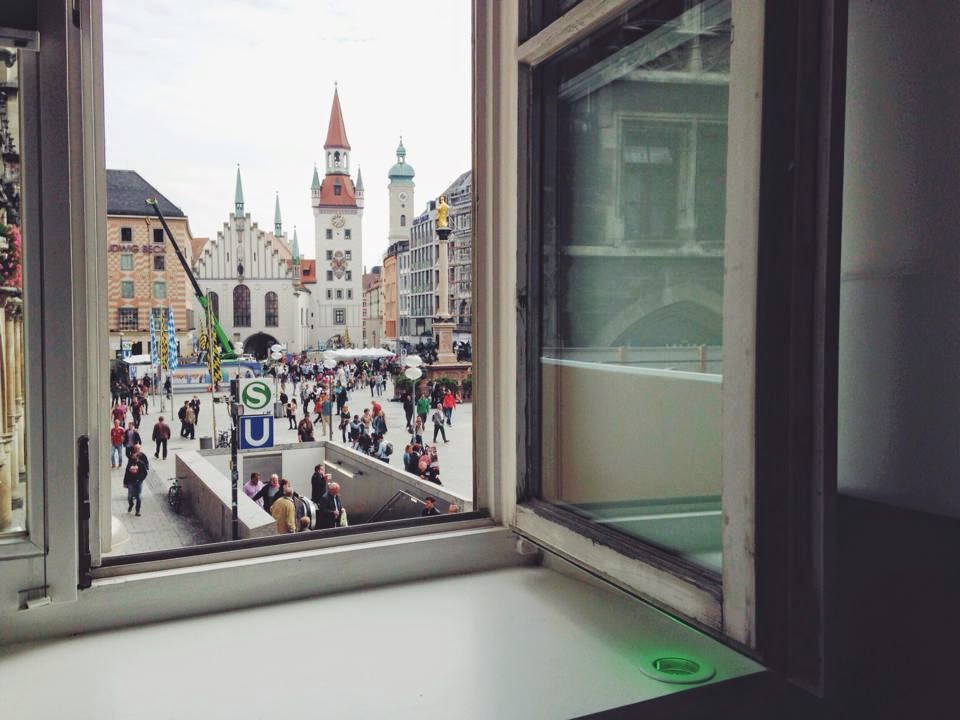
Marienplatz, Munich's central plaza
It's always the trees, scattered like seeds across a cityscape that I notice first. And then the cars, how toy like they seem, moving but a hairline along weaved strips of roadway below. The minutiae of daily life among the history and culture embedded within a city plays no role in that initial observation. It’s a carte blanche of sorts as the plane submits to gravity, diving onto the smooth stretch of the Munich runway.
My jet lag would cloak over by 8 p.m., hours after Kayli, one of my oldest camp friends, had picked me up at the airport. She guided us onto Munich’s S-bahn commuter train and on toward Feldafing, where Kayli lived with the family whom she au paired for.
By 9 p.m., we met up with Kayli’s friends at Oktoberfest, the ambience thick with the thrill of the festival’s miles long stretch of rides and tents, vomit-strewn floors, women in dirndls and men in lederhosens.
There must have been thousands crowded inside the beer halls, bodies loose with energy as we joined in, stepping up onto a picnic tabletop. The live band energized the night, positioned in the center of the hall amid ribbons and frills adorning the interior from the top down.
I’d learn on a Munich walking tour that some 70,000 visitors flock to Oktoberfest over the course of the weeklong celebration. Picture it as the Mardi Gras of Germany’s south. The celebration feeds the culture of the city where-- be you a local or visitor-- the beer glass transcends country lines: international appreciation for the Bavarian national pastime.

The craze of an Oktoberfest beer hall.
****
"Germany?" my grandparents emailed back, a response charged with the familiar tone of those who grew up in the shadows of the Second World War. My grandfather lived in London, my grandmother evacuated to Wales. Their World War II stories are ones of sirens sounded and shelters sought during the German bombing blitz of the early 1940s. For my grandparents, Germany was a threat to their country, not just to the Jewish people.
My grandfather visited Germany in 1952 as a student, returning with my grandmother in the 60s to explore, as they explain, "new Germany." Yet among the majority of Jewish grandparents, the reluctance to visit and resistance to purchase German goods remains strong. The history, after all, is personal, the scars lasting. It's our generation-- three generations since-- that is among the first to shake the reservation, removed enough so not to let Germany’s past bar us from exploring the country it’s progressed to today.
The pitter-patter of rain slows as the S-bahn approaches Stranburg, the serene stretch of a translucent lake coming into view. Contours of the dewy mountainous distance add only slight gradation to the gray-blue scheme. From here, we're about 40 minutes to Marienplatz, Munich’s main square bearing the city’s central landmarks.
My decision to visit Germany had not developed at random, as my travels never, however last minute planning, are. It was three years ago in Paris that I’d befriended Natalia and Sergej, two Germans who, despite not being Jewish, joined me my last evening in Paris for Shabbat at Chabad.

New Town Hall in Marienplatz
My Shabbats at the Champs Elysees Chabad shaped so much of the experience I took away from those six months in Paris. The people I met, the friends I made—you never know how parts of your life trickle through as the years unfold. I used to always take visitors I’d meet to Trocadero after Shabbat. It's Paris’s best view to watch the Eiffel Tower’s light show, on the hour every hour once the veil of night cloaks the city.
That last evening Natalia and Sergej gave me the company I'd offered so many others-- as we raced from Shabbat dinner to Trocadero, the two of them sitting through the blur of my tears as the flicker of the tower’s dancing bulbs twisted my torn heart.
It seems so small in retrospect, but Natalia and Sergej’s selflessness served one of the early catalysts that would set me in motion to consider Germans today away from my preconceptions defined from a war seven decades ago.
Choosing to visit Germany challenged me to consider a world that has made steps toward accepting, with structure in place to never forget. No one asks us to forgive. But we can choose to push aside and enter proud—proud of the Jewish heritage that persists today decades since any plan to once rid it from existence.
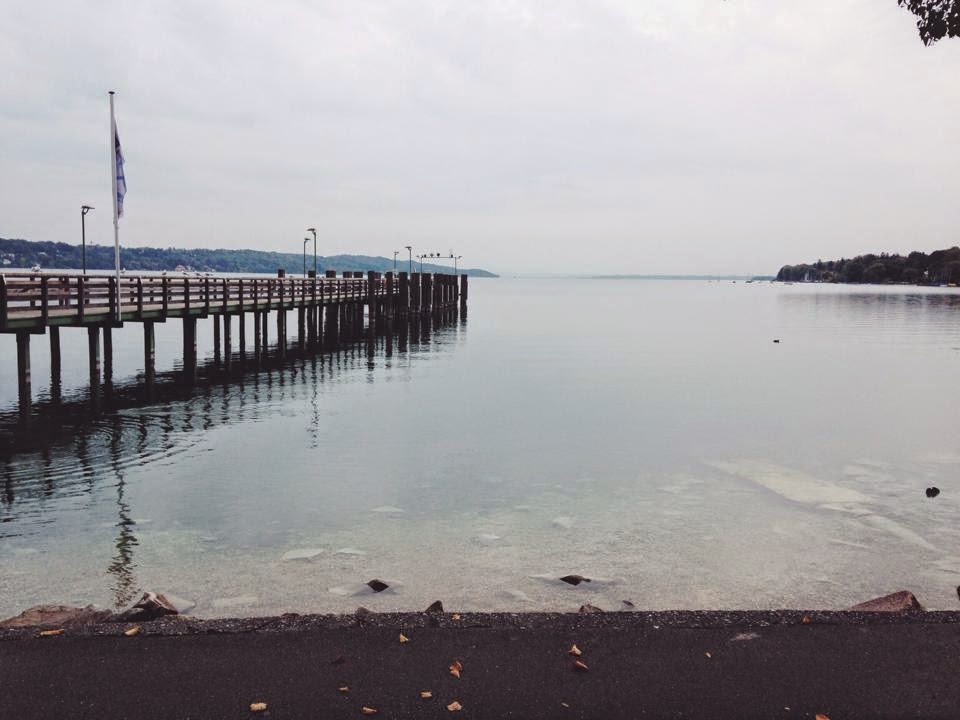
The lake at Stranburg. From here, it's about 40 minutes to Munich's city center.
****
I spent my first two days in Munich exploring the travel book’s recommendations: stifling the giggles as I assessed a scene of sunbathing nude elders at the Englischer Garten; delving into World War I history at the Jewish Museum; and paying respects to Olympia Stadion’s memorial to the Israeli athletes kidnapped and killed by Palestinian terrorists.
Day one, however, began as I love to start first days in any new city:
Simply, walking around.
****
When in Europe, fashion flare over utilitarian comfort holds. Until your back gives out, and your shoulders hurt and holes form under your shoes. And whatever notion of looking semi a-la-mode in white flats with gold tips so quickly dissipates in lieu of the tourist in sneakers appeal.
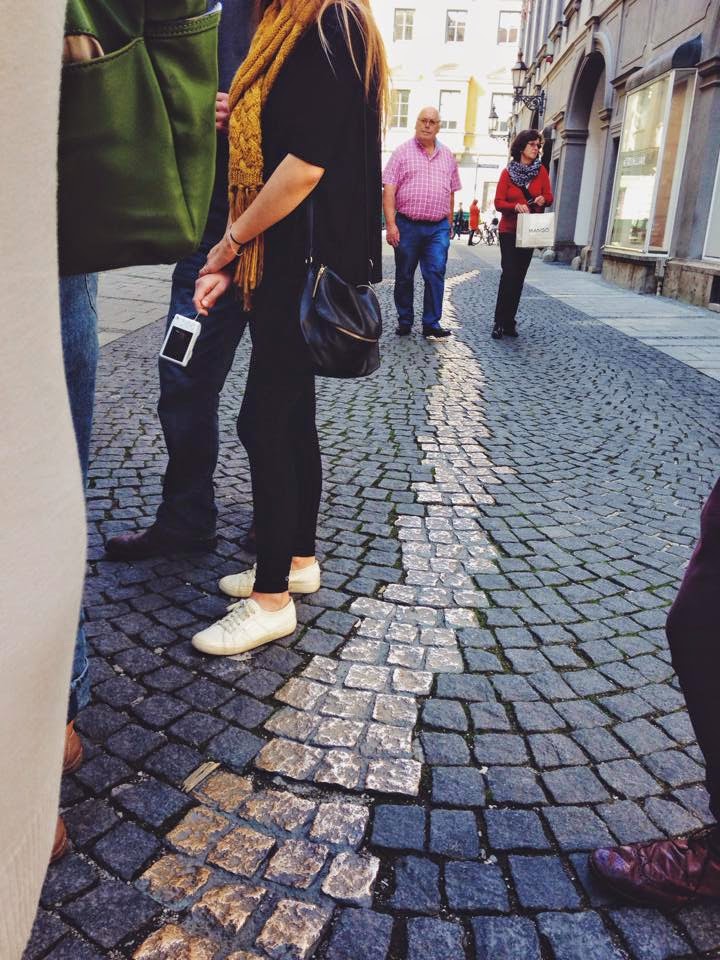 Our group’s footsteps slowed as we—a group of 23 on a three-hour walking tour— approached the alleyway. I peered down, trailing the scaled rings curved around a thick weave of golden stones.
Germans, our guide explained, would sneak down this very path in World War II's early days to avoid saluting the SS stop around the corner. But as SS officers caught wind of the cut through, they shifted their efforts to patrol of the passageway. Those with neither adequate reason to enter nor proof of identity were publicly beaten or shot.
“These golden steps here honor the courage of those Nazi resistors," our guide said. He was a husky man, his blue rugged jeans sagging clumsily over beaten sneakers. “Think of life under Nazi rule. Of the Germans with a family to support, children to raise, a life to protect," he urged. "Were you guilty if you didn’t resist the Nazis?"
My gaze traced the golden design, spokes of moss spotting ridges between stones. I’m quick to consider the Jewish plight under Nazi rule. But how often do I remember those who risked their lives to protect others from threat? The culture of memory pervades the very essence of how we understand history, framing the heroes and villains within. But what-- or better yet, who-- defines the one who did wrong? Were you guilty if you didn’t defy Nazi oppression?
It's hard to imagine Munich once patrolled by Nazi officers, of swastikas blazed onto blood red flags draping building exteriors. What did it mean to be guilty? And what relevance does it hold, seventy years later?
 There’s no simple answer, in the way the Holocaust is not a black and white story. Yet, no one asks us to forgive, and no one mandates that we answer. The scars of Germany’s past undoubtedly shape the framework of the country’s character, an ever reminder of the evil of man unto the framework of society. But the brutality of their Nazi history, the persecution of Jews before, and the country’s split following is not a story Germans shy away from. And so we can choose to push aside-- to bear to witness the memory of the Holocaust's victims, and take a moment to consider the courage of those who resisted Nazi rule.
"Were you guilty?" our guide repeated, eyeing us carefully. "And if so, how guilty?" He sighed deeply, the breath compressing into his chest.
My gaze swept along the curved design, the golden color contrasting beautifully against the rich purple of the paved walkway. It’s the golden lining of a lesson for us all—of our potential to meet valor and courage, bravery and perseverance in the face of cruelty and horror.
I didn't come to an answer that morning, and haven't in the weeks since. For perhaps seventy years after a war that scarred and shaped Germany as it stands today, perhaps it's ok not to have an answer.
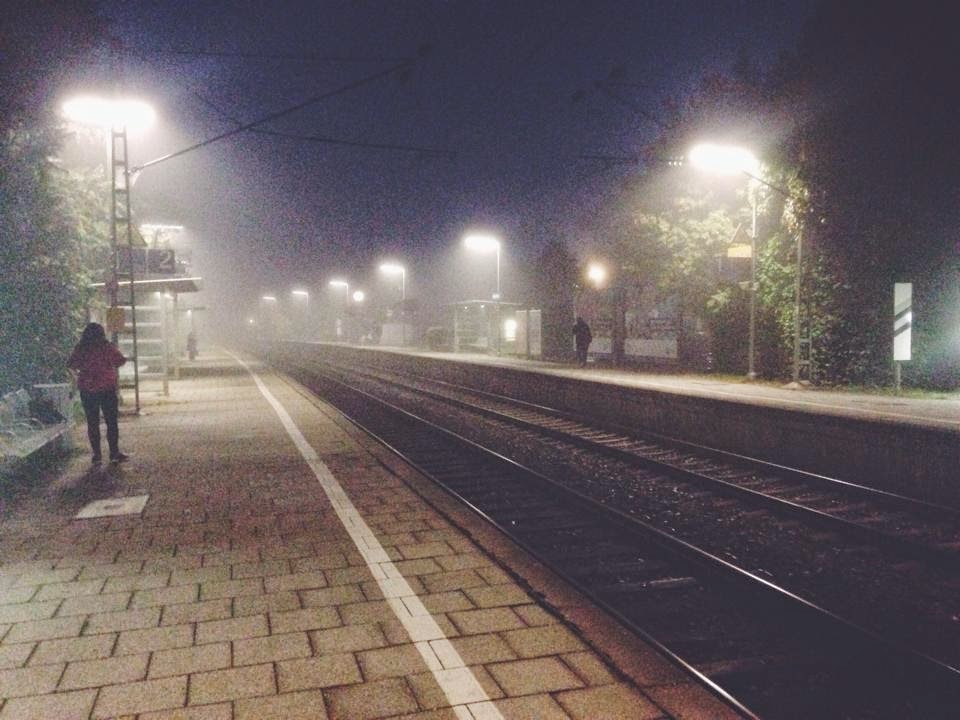
S-bahn stop at Feldafing, where Kayli lived and I stayed.
Photo taken in the early hours of the morning, as I took the train to the airport-- leaving Munich and en route to Berlin.
September 27, 2014
New York City - JFK Airport
The carry-on’s clutch shook as he clenched the handle’s grip, impatience fueling frustration. “This line,” he muttered, a mopped shag twisting to the exasperated shake of his head.
The man leaned over, surveying the curved JFK security line in front. Passengers and baggage snaked long ahead from where he stood, I watching from behind. The line mandated commitment. Commitment spiked with a generous pinch of patience.
In the security line of an international airport, worlds so easily collide despite check in signs for countries where cultures divide. But here in the queue itself, we’re all one and the same. A parade of ants trudging forward: the gift of speed handed over for the power of patience.
“Passport,” the gruffness of the officer’s tone connoted one of a man rooted in his seat far longer than the hour I’d stood waiting. The officer nodded sharply, maneuvering me robotically along the motions of the stringent U.S. airport process. My orange case-- the same that's followed my travels from Thailand onward-- slid through the mouth of the security reel. I tugged the clutch upward and suitcase forward.
50 minutes left until takeoff.
****
September 28- October 2, 2014
Munich, Germany
Marienplatz, Munich's central plaza
It's always the trees, scattered like seeds across a cityscape that I notice first. And then the cars, how toy like they seem, moving but a hairline along weaved strips of roadway below. The minutiae of daily life among the history and culture embedded within a city plays no role in that initial observation. It’s a carte blanche of sorts as the plane submits to gravity, diving onto the smooth stretch of the Munich runway.
My jet lag would cloak over by 8 p.m., hours after Kayli, one of my oldest camp friends, had picked me up at the airport. She guided us onto Munich’s S-bahn commuter train and on toward Feldafing, where Kayli lived with the family whom she au paired for.
By 9 p.m., we met up with Kayli’s friends at Oktoberfest, the ambience thick with the thrill of the festival’s miles long stretch of rides and tents, vomit-strewn floors, women in dirndls and men in lederhosens.
There must have been thousands crowded inside the beer halls, bodies loose with energy as we joined in, stepping up onto a picnic tabletop. The live band energized the night, positioned in the center of the hall amid ribbons and frills adorning the interior from the top down.
I’d learn on a Munich walking tour that some 70,000 visitors flock to Oktoberfest over the course of the weeklong celebration. Picture it as the Mardi Gras of Germany’s south. The celebration feeds the culture of the city where-- be you a local or visitor-- the beer glass transcends country lines: international appreciation for the Bavarian national pastime.
The craze of an Oktoberfest beer hall.
****
"Germany?" my grandparents emailed back, a response charged with the familiar tone of those who grew up in the shadows of the Second World War. My grandfather lived in London, my grandmother evacuated to Wales. Their World War II stories are ones of sirens sounded and shelters sought during the German bombing blitz of the early 1940s. For my grandparents, Germany was a threat to their country, not just to the Jewish people.
My grandfather visited Germany in 1952 as a student, returning with my grandmother in the 60s to explore, as they explain, "new Germany." Yet among the majority of Jewish grandparents, the reluctance to visit and resistance to purchase German goods remains strong. The history, after all, is personal, the scars lasting. It's our generation-- three generations since-- that is among the first to shake the reservation, removed enough so not to let Germany’s past bar us from exploring the country it’s progressed to today.
The pitter-patter of rain slows as the S-bahn approaches Stranburg, the serene stretch of a translucent lake coming into view. Contours of the dewy mountainous distance add only slight gradation to the gray-blue scheme. From here, we're about 40 minutes to Marienplatz, Munich’s main square bearing the city’s central landmarks.
My decision to visit Germany had not developed at random, as my travels never, however last minute planning, are. It was three years ago in Paris that I’d befriended Natalia and Sergej, two Germans who, despite not being Jewish, joined me my last evening in Paris for Shabbat at Chabad.
New Town Hall in Marienplatz
My Shabbats at the Champs Elysees Chabad shaped so much of the experience I took away from those six months in Paris. The people I met, the friends I made—you never know how parts of your life trickle through as the years unfold. I used to always take visitors I’d meet to Trocadero after Shabbat. It's Paris’s best view to watch the Eiffel Tower’s light show, on the hour every hour once the veil of night cloaks the city.
That last evening Natalia and Sergej gave me the company I'd offered so many others-- as we raced from Shabbat dinner to Trocadero, the two of them sitting through the blur of my tears as the flicker of the tower’s dancing bulbs twisted my torn heart.
It seems so small in retrospect, but Natalia and Sergej’s selflessness served one of the early catalysts that would set me in motion to consider Germans today away from my preconceptions defined from a war seven decades ago.
Choosing to visit Germany challenged me to consider a world that has made steps toward accepting, with structure in place to never forget. No one asks us to forgive. But we can choose to push aside and enter proud—proud of the Jewish heritage that persists today decades since any plan to once rid it from existence.
The lake at Stranburg. From here, it's about 40 minutes to Munich's city center.
****
I spent my first two days in Munich exploring the travel book’s recommendations: stifling the giggles as I assessed a scene of sunbathing nude elders at the Englischer Garten; delving into World War I history at the Jewish Museum; and paying respects to Olympia Stadion’s memorial to the Israeli athletes kidnapped and killed by Palestinian terrorists.
Day one, however, began as I love to start first days in any new city:
Simply, walking around.
****
When in Europe, fashion flare over utilitarian comfort holds. Until your back gives out, and your shoulders hurt and holes form under your shoes. And whatever notion of looking semi a-la-mode in white flats with gold tips so quickly dissipates in lieu of the tourist in sneakers appeal.
Our group’s footsteps slowed as we—a group of 23 on a three-hour walking tour— approached the alleyway. I peered down, trailing the scaled rings curved around a thick weave of golden stones.
Germans, our guide explained, would sneak down this very path in World War II's early days to avoid saluting the SS stop around the corner. But as SS officers caught wind of the cut through, they shifted their efforts to patrol of the passageway. Those with neither adequate reason to enter nor proof of identity were publicly beaten or shot.
“These golden steps here honor the courage of those Nazi resistors," our guide said. He was a husky man, his blue rugged jeans sagging clumsily over beaten sneakers. “Think of life under Nazi rule. Of the Germans with a family to support, children to raise, a life to protect," he urged. "Were you guilty if you didn’t resist the Nazis?"
My gaze traced the golden design, spokes of moss spotting ridges between stones. I’m quick to consider the Jewish plight under Nazi rule. But how often do I remember those who risked their lives to protect others from threat? The culture of memory pervades the very essence of how we understand history, framing the heroes and villains within. But what-- or better yet, who-- defines the one who did wrong? Were you guilty if you didn’t defy Nazi oppression?
It's hard to imagine Munich once patrolled by Nazi officers, of swastikas blazed onto blood red flags draping building exteriors. What did it mean to be guilty? And what relevance does it hold, seventy years later?
There’s no simple answer, in the way the Holocaust is not a black and white story. Yet, no one asks us to forgive, and no one mandates that we answer. The scars of Germany’s past undoubtedly shape the framework of the country’s character, an ever reminder of the evil of man unto the framework of society. But the brutality of their Nazi history, the persecution of Jews before, and the country’s split following is not a story Germans shy away from. And so we can choose to push aside-- to bear to witness the memory of the Holocaust's victims, and take a moment to consider the courage of those who resisted Nazi rule.
"Were you guilty?" our guide repeated, eyeing us carefully. "And if so, how guilty?" He sighed deeply, the breath compressing into his chest.
My gaze swept along the curved design, the golden color contrasting beautifully against the rich purple of the paved walkway. It’s the golden lining of a lesson for us all—of our potential to meet valor and courage, bravery and perseverance in the face of cruelty and horror.
I didn't come to an answer that morning, and haven't in the weeks since. For perhaps seventy years after a war that scarred and shaped Germany as it stands today, perhaps it's ok not to have an answer.
S-bahn stop at Feldafing, where Kayli lived and I stayed.
Photo taken in the early hours of the morning, as I took the train to the airport-- leaving Munich and en route to Berlin.
New York City - JFK Airport
The man leaned over, surveying the curved JFK security line in front. Passengers and baggage snaked long ahead from where he stood, I watching from behind. The line mandated commitment. Commitment spiked with a generous pinch of patience.
In the security line of an international airport, worlds so easily collide despite check in signs for countries where cultures divide. But here in the queue itself, we’re all one and the same. A parade of ants trudging forward: the gift of speed handed over for the power of patience.
“Passport,” the gruffness of the officer’s tone connoted one of a man rooted in his seat far longer than the hour I’d stood waiting. The officer nodded sharply, maneuvering me robotically along the motions of the stringent U.S. airport process. My orange case-- the same that's followed my travels from Thailand onward-- slid through the mouth of the security reel. I tugged the clutch upward and suitcase forward.
50 minutes left until takeoff.
****
September 28- October 2, 2014
Munich, Germany
|
| Marienplatz, Munich's central plaza |
It's always the trees, scattered like seeds across a cityscape that I notice first. And then the cars, how toy like they seem, moving but a hairline along weaved strips of roadway below. The minutiae of daily life among the history and culture embedded within a city plays no role in that initial observation. It’s a carte blanche of sorts as the plane submits to gravity, diving onto the smooth stretch of the Munich runway.
My jet lag would cloak over by 8 p.m., hours after Kayli, one of my oldest camp friends, had picked me up at the airport. She guided us onto Munich’s S-bahn commuter train and on toward Feldafing, where Kayli lived with the family whom she au paired for.
My jet lag would cloak over by 8 p.m., hours after Kayli, one of my oldest camp friends, had picked me up at the airport. She guided us onto Munich’s S-bahn commuter train and on toward Feldafing, where Kayli lived with the family whom she au paired for.
By 9 p.m., we met up with Kayli’s friends at Oktoberfest, the ambience thick with the thrill of the festival’s miles long stretch of rides and tents, vomit-strewn floors, women in dirndls and men in lederhosens.
There must have been thousands crowded inside the beer halls, bodies loose with energy as we joined in, stepping up onto a picnic tabletop. The live band energized the night, positioned in the center of the hall amid ribbons and frills adorning the interior from the top down.
I’d learn on a Munich walking tour that some 70,000 visitors flock to Oktoberfest over the course of the weeklong celebration. Picture it as the Mardi Gras of Germany’s south. The celebration feeds the culture of the city where-- be you a local or visitor-- the beer glass transcends country lines: international appreciation for the Bavarian national pastime.
The craze of an Oktoberfest beer hall.
****
"Germany?" my grandparents emailed back, a response charged with the familiar tone of those who grew up in the shadows of the Second World War. My grandfather lived in London, my grandmother evacuated to Wales. Their World War II stories are ones of sirens sounded and shelters sought during the German bombing blitz of the early 1940s. For my grandparents, Germany was a threat to their country, not just to the Jewish people.
My grandfather visited Germany in 1952 as a student, returning with my grandmother in the 60s to explore, as they explain, "new Germany." Yet among the majority of Jewish grandparents, the reluctance to visit and resistance to purchase German goods remains strong. The history, after all, is personal, the scars lasting. It's our generation-- three generations since-- that is among the first to shake the reservation, removed enough so not to let Germany’s past bar us from exploring the country it’s progressed to today.
The pitter-patter of rain slows as the S-bahn approaches Stranburg, the serene stretch of a translucent lake coming into view. Contours of the dewy mountainous distance add only slight gradation to the gray-blue scheme. From here, we're about 40 minutes to Marienplatz, Munich’s main square bearing the city’s central landmarks.
My decision to visit Germany had not developed at random, as my travels never, however last minute planning, are. It was three years ago in Paris that I’d befriended Natalia and Sergej, two Germans who, despite not being Jewish, joined me my last evening in Paris for Shabbat at Chabad.
New Town Hall in Marienplatz
My Shabbats at the Champs Elysees Chabad shaped so much of the experience I took away from those six months in Paris. The people I met, the friends I made—you never know how parts of your life trickle through as the years unfold. I used to always take visitors I’d meet to Trocadero after Shabbat. It's Paris’s best view to watch the Eiffel Tower’s light show, on the hour every hour once the veil of night cloaks the city.
That last evening Natalia and Sergej gave me the company I'd offered so many others-- as we raced from Shabbat dinner to Trocadero, the two of them sitting through the blur of my tears as the flicker of the tower’s dancing bulbs twisted my torn heart.
It seems so small in retrospect, but Natalia and Sergej’s selflessness served one of the early catalysts that would set me in motion to consider Germans today away from my preconceptions defined from a war seven decades ago.
Choosing to visit Germany challenged me to consider a world that has made steps toward accepting, with structure in place to never forget. No one asks us to forgive. But we can choose to push aside and enter proud—proud of the Jewish heritage that persists today decades since any plan to once rid it from existence.
|
| The craze of an Oktoberfest beer hall. |
"Germany?" my grandparents emailed back, a response charged with the familiar tone of those who grew up in the shadows of the Second World War. My grandfather lived in London, my grandmother evacuated to Wales. Their World War II stories are ones of sirens sounded and shelters sought during the German bombing blitz of the early 1940s. For my grandparents, Germany was a threat to their country, not just to the Jewish people.
My grandfather visited Germany in 1952 as a student, returning with my grandmother in the 60s to explore, as they explain, "new Germany." Yet among the majority of Jewish grandparents, the reluctance to visit and resistance to purchase German goods remains strong. The history, after all, is personal, the scars lasting. It's our generation-- three generations since-- that is among the first to shake the reservation, removed enough so not to let Germany’s past bar us from exploring the country it’s progressed to today.
The pitter-patter of rain slows as the S-bahn approaches Stranburg, the serene stretch of a translucent lake coming into view. Contours of the dewy mountainous distance add only slight gradation to the gray-blue scheme. From here, we're about 40 minutes to Marienplatz, Munich’s main square bearing the city’s central landmarks.
My decision to visit Germany had not developed at random, as my travels never, however last minute planning, are. It was three years ago in Paris that I’d befriended Natalia and Sergej, two Germans who, despite not being Jewish, joined me my last evening in Paris for Shabbat at Chabad.
|
| New Town Hall in Marienplatz |
Choosing to visit Germany challenged me to consider a world that has made steps toward accepting, with structure in place to never forget. No one asks us to forgive. But we can choose to push aside and enter proud—proud of the Jewish heritage that persists today decades since any plan to once rid it from existence.
|
| The lake at Stranburg. From here, it's about 40 minutes to Munich's city center. |
****
I spent my first two days in Munich exploring the travel book’s recommendations: stifling the giggles as I assessed a scene of sunbathing nude elders at the Englischer Garten; delving into World War I history at the Jewish Museum; and paying respects to Olympia Stadion’s memorial to the Israeli athletes kidnapped and killed by Palestinian terrorists.
Day one, however, began as I love to start first days in any new city:
Simply, walking around.
****
When in Europe, fashion flare over utilitarian comfort holds. Until your back gives out, and your shoulders hurt and holes form under your shoes. And whatever notion of looking semi a-la-mode in white flats with gold tips so quickly dissipates in lieu of the tourist in sneakers appeal.
Our group’s footsteps slowed as we—a group of 23 on a three-hour walking tour— approached the alleyway. I peered down, trailing the scaled rings curved around a thick weave of golden stones.
Germans, our guide explained, would sneak down this very path in World War II's early days to avoid saluting the SS stop around the corner. But as SS officers caught wind of the cut through, they shifted their efforts to patrol of the passageway. Those with neither adequate reason to enter nor proof of identity were publicly beaten or shot.
“These golden steps here honor the courage of those Nazi resistors," our guide said. He was a husky man, his blue rugged jeans sagging clumsily over beaten sneakers. “Think of life under Nazi rule. Of the Germans with a family to support, children to raise, a life to protect," he urged. "Were you guilty if you didn’t resist the Nazis?"
My gaze traced the golden design, spokes of moss spotting ridges between stones. I’m quick to consider the Jewish plight under Nazi rule. But how often do I remember those who risked their lives to protect others from threat? The culture of memory pervades the very essence of how we understand history, framing the heroes and villains within. But what-- or better yet, who-- defines the one who did wrong? Were you guilty if you didn’t defy Nazi oppression?
It's hard to imagine Munich once patrolled by Nazi officers, of swastikas blazed onto blood red flags draping building exteriors. What did it mean to be guilty? And what relevance does it hold, seventy years later?
“These golden steps here honor the courage of those Nazi resistors," our guide said. He was a husky man, his blue rugged jeans sagging clumsily over beaten sneakers. “Think of life under Nazi rule. Of the Germans with a family to support, children to raise, a life to protect," he urged. "Were you guilty if you didn’t resist the Nazis?"
My gaze traced the golden design, spokes of moss spotting ridges between stones. I’m quick to consider the Jewish plight under Nazi rule. But how often do I remember those who risked their lives to protect others from threat? The culture of memory pervades the very essence of how we understand history, framing the heroes and villains within. But what-- or better yet, who-- defines the one who did wrong? Were you guilty if you didn’t defy Nazi oppression?
It's hard to imagine Munich once patrolled by Nazi officers, of swastikas blazed onto blood red flags draping building exteriors. What did it mean to be guilty? And what relevance does it hold, seventy years later?
There’s no simple answer, in the way the Holocaust is not a black and white story. Yet, no one asks us to forgive, and no one mandates that we answer. The scars of Germany’s past undoubtedly shape the framework of the country’s character, an ever reminder of the evil of man unto the framework of society. But the brutality of their Nazi history, the persecution of Jews before, and the country’s split following is not a story Germans shy away from. And so we can choose to push aside-- to bear to witness the memory of the Holocaust's victims, and take a moment to consider the courage of those who resisted Nazi rule."Were you guilty?" our guide repeated, eyeing us carefully. "And if so, how guilty?" He sighed deeply, the breath compressing into his chest.
My gaze swept along the curved design, the golden color contrasting beautifully against the rich purple of the paved walkway. It’s the golden lining of a lesson for us all—of our potential to meet valor and courage, bravery and perseverance in the face of cruelty and horror.
I didn't come to an answer that morning, and haven't in the weeks since. For perhaps seventy years after a war that scarred and shaped Germany as it stands today, perhaps it's ok not to have an answer.
|
| S-bahn stop at Feldafing, where Kayli lived and I stayed. Photo taken in the early hours of the morning, as I took the train to the airport-- leaving Munich and en route to Berlin. |


